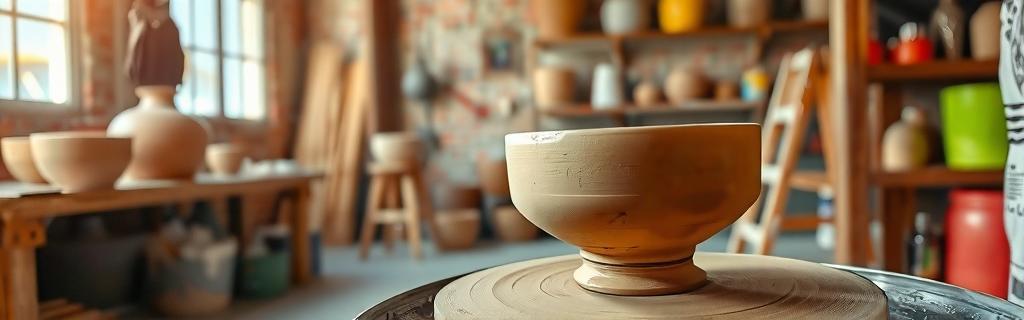
Hey fellow creatives! Are you ready to dive headfirst into the mesmerizing world of pottery? There’s something truly magical about taking a lump of raw clay and, with a little skill and a lot of love, transforming it into a functional piece of art. For centuries, the potter’s wheel has been the heart of this craft, and I’m here to guide you through your first exhilarating spins! This guide is the perfect beginner crash-course! Even if you aren’t sure about using a potter’s wheel, by the end of this you are going to be as stoked as I am about pottery!
- Decoding the Clay: A Potter’s Palette
- Wedging: Clay Massage Time
- Mastering the Machine: A Beginner’s Manual to Operating the Wheel
- Centering: Taming the Beast
- Breathing Life: Throwing Your First Piece
- Tips and Tricks for Beginners
- In Conclusion
Decoding the Clay: A Potter’s Palette
Before we even touch the wheel, let’s talk clay – the soul of our creations. Think of it like a painter choosing their colors; understanding the different types of clay is crucial. But, as I always say, clay is much easier to clean! Now, there’s plenty to consider; texture, cone size, price- so without further ado, here’s my handy guide to navigate through this fundamental artistic substance!
Earthenware: The Friendly First Date
This is the clay that’s most forgiving, perfect for beginners. It’s porous and soft, making it a dream to mold.
Best For: Initial explorations, decorative pieces, terracotta projects.
Stoneware: The Reliable Companion
Strong, versatile, and ready for daily use. Stoneware can handle the heat, so go ahead and microwave that morning coffee!
Best For: Mugs, plates, vases – your everyday pottery essentials.
Porcelain: The Elegant Artist
Oh, porcelain, you delicate beauty! It’s translucent and fine, but definitely needs a seasoned hand.
Best For: High-end ceramics, sculptures, projects meant to stun.
Ball Clay: The Secret Ingredient
This clay is what is referred to as high plasticity. This is important because clay is used as blends to strengthen other clays by adding strength.
Best For: If you want a clay that adds plasticity to your clay blends then this will be great. On its own this clay shrinks a concerning amount while firing.
Key Considerations
Don’t forget the fine print! Here is what to keep in mind for each blend.
- Shrinkage: All clay is subject to 5% to 15% range, all based on clay blend.
- Absorption: After firing, clay retains anywhere between 0% to 15% of water based on blend.
- Plasticity: All clay has the ability to stretch and contort before potentially breaking; based on the blend this varies.
For your maiden voyage on the wheel, I wholeheartedly recommend stoneware. It’s strong enough to withstand a bit of clumsiness (we’ve all been there!), yet pliable enough to let you find your flow.
Wedging: Clay Massage Time
Before we dominate a beautiful piece we need to prepare that clay! Clay is an artistic dough that needs to be properly prepared to avoid unfortunate lumps! I will be describing how to fold and knead the clay while simultaneously extracting air from it, think of it as a spa day for the clay!
How To Wedge
Roll forward and downwards, slowly folding the clay into itself one layer at a time. I consider this almost like meditation. A little practice will be required before you know all there is to know; but do not get discouraged!
Mastering the Machine: A Beginner’s Manual to Operating the Wheel
Alright! Time to harness the magic of the potter’s wheel itself. It may seem daunting, but trust me, it’s easier than riding a bike (and way less likely to result in scraped knees!). Here’s the lowdown:
Powering Up
It comes to life through a foot pedal. A few wheels use a simple on/off switch or a knob to control the speed.
Direction
Right-handed potter? – You’ll want that wheel to turn counter-clockwise.
Left-handed potter? – Set that wheel to turn clockwise for max efficiency and smooth movement.
Pedal Power
The foot pedal controls the speed of the wheel. Gently press the pedal to increase the speed and release it to slow down. Practice controlling the speed with your foot to get a feel for the wheel.
The Faster, The Better
Begin with the wheel on its fastest mode to make your center creation easier. As you get the height you want, gradually bring that speed down to avoid toppling your creation.
Centering: Taming the Beast
Alright! The moment we have both been waiting for! First you should remember; CENTERING IS KING! Take it from me- the single most important process to all processes that comes next is centering!
I cannot express enough the frustration of poorly prepared centering so follow carefully:
Prepare the bat
Clean the bat (the flat disc attached to the wheel head) by scraping off any excess clay.
Attach the clay
Moisten the center of the bat and firmly slam your ball of clay onto the center.
Secure the clay
Use your index finger to seal the bottom of the clay to the bat as the wheel spins.
Cone up
With your elbows braced against your body, use your hands to push the clay upwards into a cone shape.
Cone down
Press down on the clay with a flat palm to cone it down, while using your other hand to prevent it from protruding too much.
Repeat
Continue coning up and down, adding water as needed, until the clay is perfectly centered.
After performing the above steps enough on your wheel, the lump of clay you placed on it should feel still; no wiggles! Your clay now knows who is boss!
Breathing Life: Throwing Your First Piece
Once the clay is centered, you’re ready to start shaping it. Remember, when shaping, your goal is to not fight with your wheel, the potter and the wheel are a team! Here’s how:
Make Your Opening
Create a well in the center of the clay by pressing down with your thumbs.
Widen
Use your fingers to widen the well and create the opening for your piece. Make sure to leave enough clay at the bottom for the base of your piece.
Pull
Slowly pull the walls of the clay upwards with your fingers to create the desired shape. Keep your hands close together and maintain an even pressure to ensure consistent wall thickness.
Shaping
Here comes the artist! Use your fingers, sponges, and ribs to refine the shape and smooth the surface of your piece.
Trimming
Once the piece is leather-hard (partially dry), you can trim the bottom and refine the foot.
Tips and Tricks for Beginners
Embarking on your pottery journey? Here are a few pearls of wisdom I’ve gathered over the years to guide your path:
- Start Small, Dream Big: Begin with manageable amounts of clay (around 2 pounds is perfect) to get comfortable with the wheel’s rhythm. Less clay means fewer frustrations in those early stages!
- Consistency is Key: The more you spin, the better you’ll become! Consistent practice is the secret to mastering centering, pulling, and shaping. Even short, regular sessions can make a huge difference.
- Embrace the Wobble: Don’t fear the imperfections! Mistakes are your greatest teachers. Embrace the learning process, and remember that every wobbly pot brings you closer to creating a masterpiece.
- Water is Your Friend: Keep the clay and your hands well-lubricated with water to prevent sticking and friction. A smooth, hydrated surface allows the clay to glide effortlessly beneath your fingers.
- Patience: Pottery requires time and patience. Don’t be discouraged if your first attempts aren’t perfect. Each throw is a learning opportunity.
- Technique Over Brawn: Proper body position and leverage are more important than brute strength. If something hurts, you’re probably doing it wrong. Listen to your body, and adjust your technique accordingly.
- Mind Your Speed: Move slowly and deliberately, even when the wheel is spinning quickly. Rushing can cause the pot to become off-center. Trust me, patience pays off in the end!
- Seek Help From Others: Consider joining a pottery class or workshop. Experienced instructors can provide personalized feedback, and you’ll connect with a supportive community of fellow potters.
In Conclusion
With practice, pottery provides the perfect amount of challenge while offering unique skills and lessons. I say give pottery a chance- or two- even three! Now, go get your hands dirty and unleash your inner potter!
